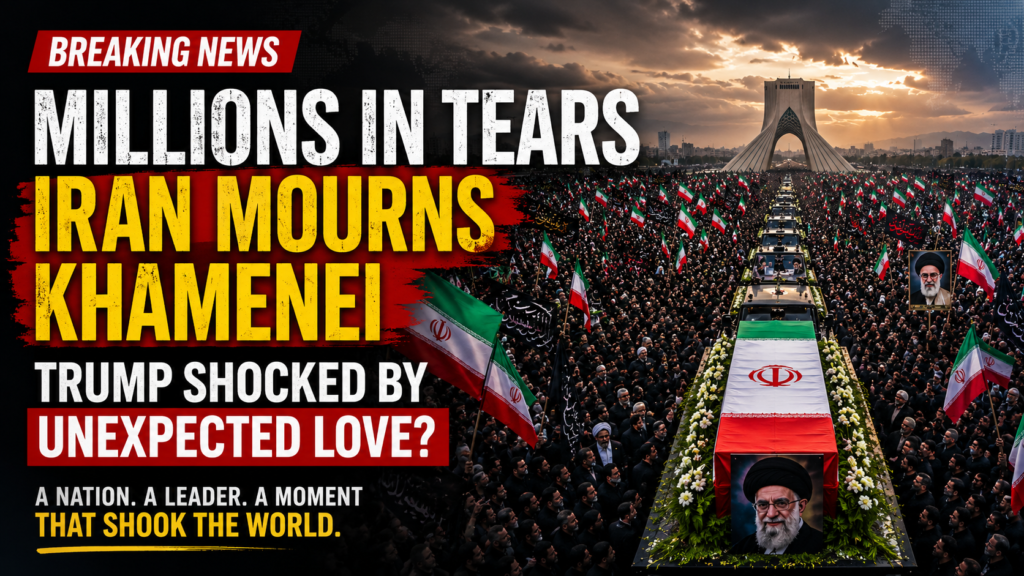
A powerful image circulating across social media has reignited international debate about public opinion inside Iran. The photograph, which appears to show an enormous crowd surrounding a funeral procession draped in Iranian flags, has been widely shared alongside a quote attributed to former U.S. President Donald Trump claiming he was “shocked” to see so many Iranians mourning Supreme Leader Ayatollah Ali Khamenei because he believed people hated him.
The image quickly attracted millions of views across Facebook, X, Instagram, and Telegram, where users expressed sharply divided opinions. Some interpreted the massive gathering as evidence that Khamenei retained significant public support despite years of criticism from Western governments and media. Others questioned the authenticity of both the image and the quote, arguing that viral content surrounding major geopolitical events often spreads faster than verified information.
Regardless of whether every claim attached to the image is accurate, one thing is certain: the photograph has once again highlighted how difficult it is to understand public opinion inside Iran from the outside.
For years, international headlines have largely focused on anti-government protests, economic sanctions, and political unrest in Iran. Demonstrations following the death of Mahsa Amini in 2022 received extensive global media coverage and created an impression among many observers that the overwhelming majority of Iranians opposed the country’s leadership. Those protests became one of the most closely watched political movements in the Middle East, leading many analysts to predict increasing pressure on the Iranian government.
However, experts on Iranian politics have repeatedly cautioned against viewing the country through a single narrative. Iran is home to more than 90 million people with diverse political, religious, and cultural perspectives. While many citizens openly criticize government policies, others continue to support the country’s leadership for ideological, religious, or nationalist reasons. Large public gatherings, particularly during major religious or political events, often reflect this complexity.
The viral funeral image has therefore become more than just a photograph. It has evolved into a symbol of competing narratives about Iran itself.
Supporters sharing the image argue that Western media has frequently overlooked demonstrations of public loyalty toward the Iranian leadership while focusing primarily on protests. They claim the funeral crowd demonstrates that millions of citizens continue to identify with the Islamic Republic despite economic challenges and international isolation.
Critics, meanwhile, argue that attendance at such public events cannot automatically be interpreted as universal political support. They note that funeral processions for prominent national figures often attract people for a variety of reasons, including religious beliefs, cultural traditions, patriotism, curiosity, or respect for the office rather than personal political loyalty. Political scientists frequently caution against drawing sweeping conclusions from a single public gathering.
The alleged Donald Trump quote attached to the image has generated an equally intense debate. Thousands of social media users have reposted the statement without providing any verified source, while others have questioned whether Trump ever made the remark publicly. As with many viral political claims, fact-checkers emphasize the importance of confirming quotations through official speeches, interviews, or verified recordings before accepting them as authentic.
This episode illustrates a broader problem facing today’s digital information environment. Artificial intelligence, edited images, recycled videos, and unattributed quotations can spread worldwide within minutes. Emotional content often receives greater engagement than carefully verified reporting, making it increasingly difficult for ordinary readers to distinguish fact from speculation.
International analysts say that perception has become one of the most powerful tools in modern geopolitics. Images of massive crowds, dramatic protests, or emotional public events frequently shape global opinion long before investigators can verify every detail. Governments, political organizations, media outlets, and online influencers all compete to influence how such events are interpreted.
Iran itself remains one of the world’s most closely watched countries because of its regional influence, nuclear program, relationship with Western powers, and role in Middle Eastern politics. Every major event involving the country’s leadership tends to receive enormous international attention, with competing narratives emerging almost immediately across different media ecosystems.
Communication experts believe this latest viral image demonstrates how social media has fundamentally changed news consumption. Instead of waiting for traditional news organizations, millions of people now encounter breaking stories first through viral posts shared by friends, influencers, or anonymous accounts. Those initial impressions often remain powerful even after additional facts become available.
For readers, the situation serves as an important reminder to approach sensational political content carefully. A striking image can capture a real moment, but the accompanying captions, quotations, and interpretations should always be examined critically. Multiple credible sources, official statements, and independent reporting remain essential for understanding complex international events.
As discussion surrounding the funeral image continues, it reflects a broader reality of today’s information age: public opinion is rarely as simple as social media headlines suggest. Iran, like many nations facing political polarization and international scrutiny, contains a wide range of voices and perspectives that cannot easily be summarized by a single photograph or viral caption.