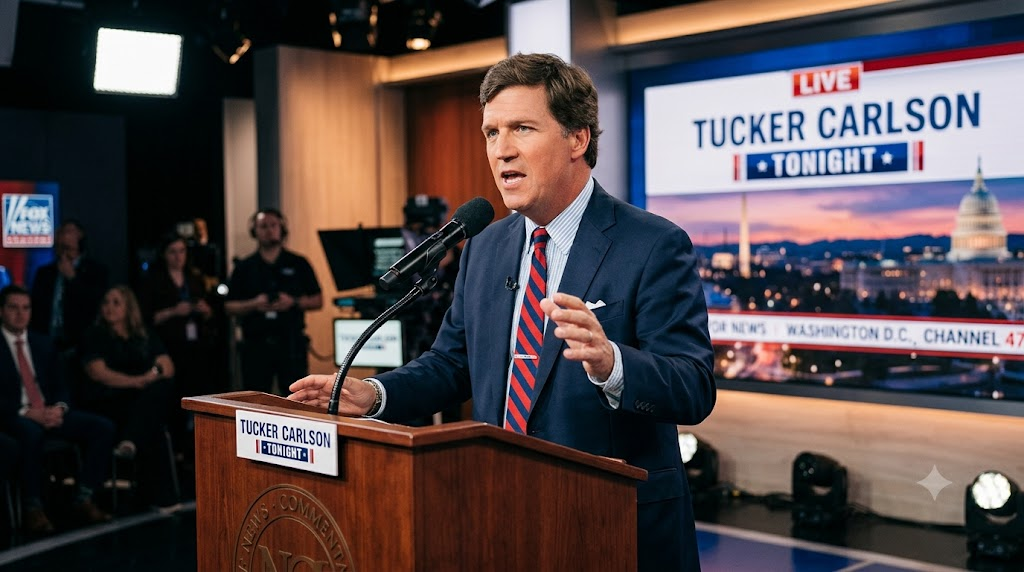
In today’s deeply polarized political climate, it is increasingly rare to see a well-known public figure openly admit they were wrong. Political commentators, television personalities, and influential voices often defend their past statements, even when evidence suggests those views were mistaken. That is why recent comments from Tucker Carlson about Islam and Muslims have attracted widespread attention and sparked an intense online conversation.
According to Carlson, there was a time when he repeated some of the most extreme claims about Islam on television. He says he genuinely believed those narratives and presented them confidently to millions of viewers. Looking back now, however, he says those beliefs were inaccurate and based on assumptions that did not reflect reality.
Whether people agree with Tucker Carlson on other issues or not, many observers believe that publicly acknowledging such a mistake is significant. Changing one’s opinion in private is one thing. Admitting that change before a global audience, especially after years of defending a particular viewpoint, is something entirely different.
Carlson’s remarks have generated strong reactions across social media. Some users have praised him for what they see as honesty and personal growth, arguing that admitting a mistake takes courage. Others remain skeptical, pointing out that his previous statements reached millions of people and may have influenced public perceptions of Muslims for years. For those critics, a simple admission does not erase the impact of earlier rhetoric.
Both perspectives have become part of a much larger discussion about accountability in modern media.
For years, conversations surrounding Islam have often been shaped by fear, political tension, terrorism-related headlines, and international conflicts. In many Western countries, these discussions sometimes created broad stereotypes that treated over a billion Muslims as though they all shared the same beliefs or actions. Critics have long argued that such generalizations ignored the diversity of Muslim communities around the world.
Carlson now says he came to realize that many of the assumptions he once repeated were simply not true. His comments suggest that personal experience, additional information, and deeper reflection led him to reconsider views he had previously expressed with certainty.
This kind of public reversal is uncommon because today’s media environment often rewards confidence rather than humility. Television debates, political commentary, and social media algorithms frequently encourage people to defend their positions as strongly as possible. Admitting a mistake is sometimes portrayed as weakness instead of maturity.
That may explain why Carlson’s comments have resonated with so many people. Regardless of political affiliation, many observers believe society benefits when influential individuals demonstrate that learning and changing are possible.
At the same time, acknowledging growth does not require ignoring the past. Many Muslims and civil rights advocates argue that words spoken by major media personalities can shape public opinion and even influence how entire communities are treated. They believe it is reasonable to recognize Carlson’s change in perspective while also remembering the effects his previous comments may have had.
This balance between accountability and personal growth is at the heart of the current debate.
The conversation also raises a broader question that extends far beyond Tucker Carlson himself. Should society encourage people to admit they were wrong, or should every mistake permanently define them? If individuals know they will never be forgiven regardless of what they do, critics argue they become less likely to acknowledge errors in the first place.
Others respond that genuine accountability requires more than words. They believe meaningful change is demonstrated over time through consistent actions, respectful dialogue, and a willingness to correct misinformation whenever possible.
Whatever position people take, Carlson’s remarks have opened an important conversation about how opinions evolve. Human beings are capable of learning, questioning long-held assumptions, and reaching different conclusions as they encounter new experiences and evidence. History is filled with public figures who changed their views on major issues after gaining a broader understanding of the world around them.
In an era dominated by outrage, viral clips, and political division, moments of honest self-reflection stand out precisely because they are so unusual. They remind us that changing one’s mind is not necessarily a sign of weakness. In many cases, it can be evidence of intellectual honesty and personal maturity.
Whether Tucker Carlson’s statement marks the beginning of a lasting shift or simply another chapter in his public career remains to be seen. But one thing is certain: his admission has reignited an important discussion about prejudice, accountability, media influence, and the value of recognizing when we have been wrong.
In a world where many people refuse to reconsider their beliefs, the willingness to publicly acknowledge a mistake has become increasingly rare. And perhaps that is why this story continues to attract attention far beyond politics itself.